How Selin Balci Turns Microorganisms Into Living Works of Art by tomorrow's World Today
In this episode, we are joined by artist Selin Balci, whose art begins not with paint but with living microorganisms.
In this episode, we are joined by artist Selin Balci, whose art begins not with paint but with living microorganisms.
Meet Selin Balci: The Artist Who Transforms Microbes Into Colorful Visual Narratives

Few practices blur the boundaries between science, nature, and creative expression as seamlessly as the work of artist Selin Balci. Her work unfolds at the microscopic scale, where mold spores,microbes and living ecologies become “collaborators,” rather than tools or materials. In this conversation with Tomorrow’s World Today, Balci reveals how her background in forestry and microbiology shaped her unique art, which transforms invisible biological processes into colorful visual narratives.
Few practices blur the boundaries between science, nature, and creative expression as seamlessly as the work of artist Selin Balci. Her work unfolds at the microscopic scale, where mold spores,microbes and living ecologies become “collaborators,” rather than tools or materials. In this conversation with Tomorrow’s World Today, Balci reveals how her background in forestry and microbiology shaped her unique art, which transforms invisible biological processes into colorful visual narratives.
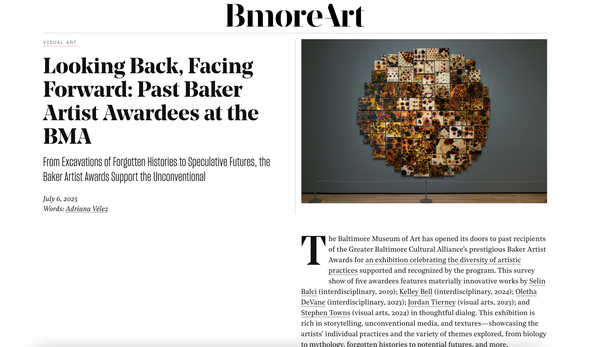
Faces, 2025 at Baltimore Museum of Art
Mushroom Spores Accompany Us at Every Step.
They are present in the air, they land on our bodies, objects, winds, and in our airways. The presence of these tiny microorganisms is made visible by artist and biologist Selin Balci. What appears to be the disintegration of a face is, in fact, another kind of portrait—and a proposal to question how identities are constructed.
In many cultures, identity is closely tied to the face. Selin Balci subverts this by reshaping the face in photographs using microorganisms, including mold spores. So what can we actually see here?
Using a Polaroid instant camera, she photographs individuals and also collects samples from their bodies—such as hair or skin swabs. With the help of a nutrient medium, fungal growth appears on the Polaroids: delicate fungal threads spread across the photo paper, giving each person a new appearance.
The resulting images differ greatly from one another, because each person has a unique composition of microorganisms on and inside their body (in the gut, on the skin, mucous membranes, genitals, etc.)—what is referred to as the microbiome.
Balci’s portraits propose a new way of thinking about identity—as truly multilayered, in every sense of the word. The poet Walt Whitman (1819–1892) likely wasn’t thinking of microorganisms when he wrote, “I am large, I contain multitudes.” And yet, so it is.
KATHRIN MEYER, journal culinaire, 11.13.2024
They are present in the air, they land on our bodies, objects, winds, and in our airways. The presence of these tiny microorganisms is made visible by artist and biologist Selin Balci. What appears to be the disintegration of a face is, in fact, another kind of portrait—and a proposal to question how identities are constructed.
In many cultures, identity is closely tied to the face. Selin Balci subverts this by reshaping the face in photographs using microorganisms, including mold spores. So what can we actually see here?
Using a Polaroid instant camera, she photographs individuals and also collects samples from their bodies—such as hair or skin swabs. With the help of a nutrient medium, fungal growth appears on the Polaroids: delicate fungal threads spread across the photo paper, giving each person a new appearance.
The resulting images differ greatly from one another, because each person has a unique composition of microorganisms on and inside their body (in the gut, on the skin, mucous membranes, genitals, etc.)—what is referred to as the microbiome.
Balci’s portraits propose a new way of thinking about identity—as truly multilayered, in every sense of the word. The poet Walt Whitman (1819–1892) likely wasn’t thinking of microorganisms when he wrote, “I am large, I contain multitudes.” And yet, so it is.
KATHRIN MEYER, journal culinaire, 11.13.2024